Beyond the Syllabus: The Dual-Impact of AI Models in Higher Education
Exploring practical strategies using AI models to help Teachers and Students to achieve their goals
EDUCATION WITH AI
3/3/20264 min read

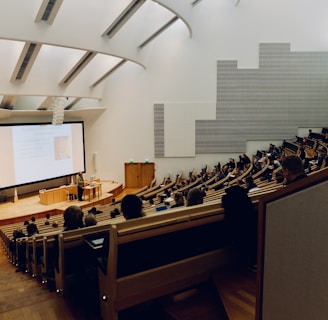
The tertiary education landscape is currently undergoing its most significant structural shift since the advent of the internet. We are moving rapidly past the initial panic of "AI detection" toward a sophisticated era of AI Literacy and integration. In high-stakes academic environments, Large Language Models (LLMs) are no longer mere novelty tools; they are becoming the fundamental infrastructure upon which research, pedagogy, and student support are being rebuilt.
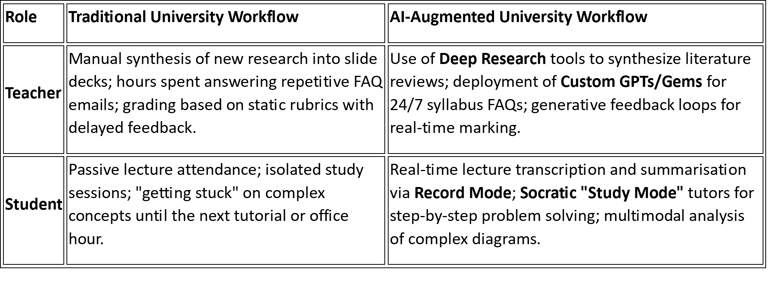
Comparative Case Study: The Academic Workflow Transformation
To understand the depth of this shift, we must examine the daily operations of the two primary stakeholders in the university ecosystem.
The Faculty Perspective: From Lecturer to Architect of Learning
For faculty, the true value of AI lies in the reclamation of time. The routine tasks in academia—like grading, scheduling, and repeated emails—often take time away from mentoring students and doing original research.
Research-to-Lecture Hyper-Efficiency: Modern models like Claude (Anthropic) offer industry-leading long-context windows, allowing researchers to upload dozens of papers to synthesize the latest findings directly into curriculum updates. Instead of weeks of preparation, a Teacher can use Retrieval-Augmented Generation (RAG) to ground lecture notes in their own specific body of work, ensuring the AI-generated content is accurate and academically rigorous.
The Specialized Teaching Assistant: Through the use of Custom GPTs or Gemini Gems, faculty can now build "subject-based AI tutors". These bots are fed the specific syllabus, marking rubrics, and lecture notes of a course. This allows students to receive standardised feedback across multiple classes while the Teacher focuses on complex student cases that require human intervention.
Automating Feedback Loops: Tools within the Microsoft and Google ecosystems now allow for the drafting of exams and the generation of rubric-based feedback. This transforms the "grading backlog" into an opportunity for Generative Feedback Loops, where students receive immediate, actionable critiques on their drafts before final submission.
The Student Perspective: The Personalized Socratic Co-Pilot
Students are no longer navigating the complexities of higher education in isolation. The shift from "AI as a cheat" to "AI as a tutor" is most evident in the rollout of Study Modes that utilise Socratic questioning.
Guided Learning: Rather than simply providing an answer, models like Gemini and ChatGPT now offer step-by-step explanations and "guiding questions" that test a student’s understanding as they progress. This "Socratic" approach fosters critical thinking rather than rote memorization.
Multimodal Accessibility: For students with diverse learning needs, AI acts as an essential accessibility bridge. NotebookLM can convert a dense textbook chapter into a "podcast-like audio overview," allowing for learning on the go. Simultaneously, interactive images allow students to click on different parts of a cell or a complex graph to receive detailed, real-time explanations.
STEM and Coding Support: For students in technical fields, interactive code blocks and GitHub Copilot provide a "pair-programming" experience. Students can debug exercises in real-time, receiving logical explanations for errors rather than just a corrected script.
The Real-World Impact: Implementing in High-Stakes Situations
The integration of AI is not limited to the lecture hall; it is fundamentally altering high-stakes academic environments.
Laboratory Simulations: AI infrastructure, driven by companies like NVIDIA, is enabling AI-generated simulations for STEM. These allow students to conduct "virtual labs" or run machine learning practicals on on-campus GPU labs before moving to physical, expensive equipment.
Thesis Drafting & Research: Deep Research tools now allow for faster academic research and structured drafting support for literature reviews. Students can use AI to brainstorm outlines and ensure citation guidance is followed, while faculty use the same models to review drafts for logical consistency.
Interdisciplinary Research: AI serves as a "translator" between complex datasets in different fields, supporting researchers in synthesizing data from disparate disciplines into a cohesive study.
The "Integrity Framework": A 5-Point Rubric for Ethical AI Use
As we shift from detection to literacy, both students and teachers need a clear rubric to distinguish between Ethical Enhancement and Plagiarism.
Source Grounding: Is the AI's output grounded in verified academic sources or the provided course material? (e.g., using NotebookLM to query a textbook).
Cognitive Contribution: Did the student use the AI to generate an answer, or did they use "Study Mode" to understand the how and why behind the concept?.
Transparency & Declaration: Has the use of AI been declared in accordance with the institution's academic code?.
Generative Feedback Loop: Is the AI being used as a "co-pilot" for iterative improvement (e.g., debugging code) rather than a "pilot" for final output?.
Data Privacy & Compliance: Does the tool meet institutional security standards (e.g., FERPA compliance) for handling sensitive student or research data?.
High-Utility Tools for Higher Education
NotebookLM (Google): For creating "content-grounded" study notebooks, audio summaries, and interactive flashcards.
ChatGPT Edu: For building custom subject-specific TAs and utilizing the "Socratic" Study Mode.
Perplexity: For real-time, source-backed academic research and discovery.
Claude (Anthropic): The leader for long-document synthesis, thesis draft reviews, and complex reasoning.
GitHub Copilot: The gold standard for CS students and STEM faculty for live debugging and pair-programming.
Conclusion: The Mandate for AI Literacy
The future of higher education is not a battle against AI, but a race toward AI Literacy. As we move toward future, we will see the rise of AI-Native Universities, where the Learning Management System (LMS) is entirely integrated with AI copilots and automated feedback systems.